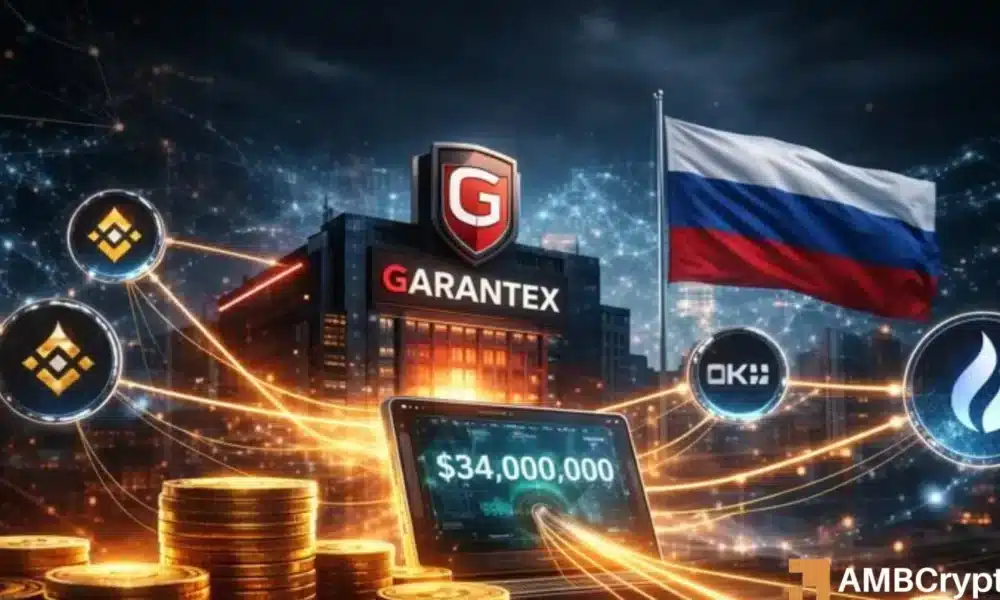
In a remarkable twist, the banned Russian crypto exchange Garantex has reemerged, showcasing a surprising ability to adapt and defy regulatory efforts. Despite facing server seizures, asset confiscations, and significant shutdown measures, Garantex has managed to rebuild a $34 million crypto pipeline, as revealed by a recent investigation by blockchain analytics firm Global Ledger.
Garantex’s Resilient Financial Network
Global Ledger’s analysis uncovered that Garantex’s financial network remains operational, with newly established Bitcoin (BTC) and Ethereum (ETH) wallets accumulating over $34 million in cryptocurrency reserves. These funds are reportedly not intended for exchange trading activities but are being strategically reserved for customer payouts—a move aimed at preserving liquidity and maintaining trust with their core users.
The investigation highlighted that at least $25 million has already been disbursed to former users, while 88% of their Ethereum reserve remains untouched. This showcases Garantex’s ability to weather shutdown attempts and preserve a war chest for future operations.
Mainstream Crypto Infrastructure Used as Liquidity Routes
A key finding from the report is Garantex’s close connection to major centralized exchanges (CEXs), ranked among the top ten globally on CoinMarketCap. These exchanges unknowingly act as liquidity routes for the banned network. This newfound evidence underscores a major challenge for regulatory bodies, as sanctioned networks continue to exploit mainstream financial systems for on- and off-ramp operations.
Russia’s Strategy: Beyond Emulating Western Innovations
Russia’s use of blockchain technology displays a unique approach, one rooted in circumventing Western sanctions while utilizing decentralized financial tools. As opposed to merely emulating U.S. blockchain innovations, Russia appears to have tailored these technologies into a scalable sanctions-evasion framework. According to researchers, successors of Garantex, such as Grinex and A7A5, are actively working to establish non-USD payment systems, aiming to weaken Western financial dominance.
This strategy aligns with Russia’s paradoxical crypto regulation policies. While imposing tight restrictions on certain digital assets, Russia’s Central Bank continues to co-opt blockchain technology for state-aligned objectives, signaling a long-term approach to building a parallel financial system.
The Role of Decentralization
Even more fascinating is Garantex’s evolution into a decentralized sanctions-evasion-as-a-service model. By leveraging Telegram workflows and agency contracts, the exchange has created a robust system designed to resist external pressure while efficiently distributing payouts. This decentralized model also enables Russia to adapt to increasing global scrutiny of its crypto operations.
The Broader Implications
The resurgence of Garantex raises significant concerns for regulators and compliance teams alike. Its ability to tap into mainstream financial systems despite sanctions demonstrates the need for more advanced monitoring and regulatory frameworks. It also fuels a larger geopolitical narrative about how blockchain technology is being weaponized to challenge established financial systems.
Interested in understanding how to protect your crypto investments while navigating a volatile market? Try the Ledger Nano X Hardware Wallet. A trusted solution for securing your Bitcoin, Ethereum, and other digital assets.