Nvidia’s Dominance and the AI Hardware Arms Race
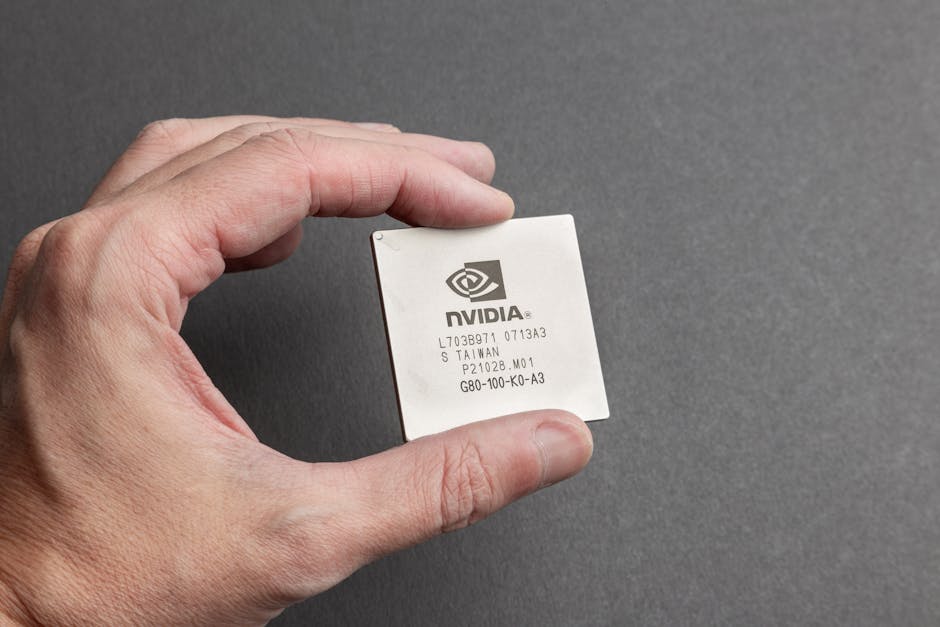
Nvidia’s stock (NVDA) rose 0.3% on April 21, 2026, approaching its all-time high of $269.96, as reported by Blockonomi. This movement occurred despite Google’s announcement of its fifth-generation Tensor Processing Units (TPUs), signaling a direct offensive in the AI chip market. The resilience of Nvidia’s stock, which closed at $268.05, underscores the company’s entrenched position, largely credited to its proprietary CUDA software platform.
KeyBanc Capital Markets analyst John Vinh highlighted this “CUDA moat” as a primary reason for maintaining an Overweight rating and a $275 price target. CUDA is the parallel computing platform and programming model that allows developers to leverage Nvidia GPUs for general-purpose processing. This ecosystem, built over 15+ years, creates a significant barrier to entry for competitors like Google, AMD, and Intel. While Google’s new v5e and v5p TPUs promise improved performance and cost-efficiency for AI training and inference, they must contend with the massive inertia of the existing CUDA-based development world.
The financial stakes are colossal. Nvidia’s data center revenue, driven by AI chip demand, surged to $47.5 billion in its last fiscal year. Google, Amazon (with its Trainium and Inferentia chips), and Microsoft are investing billions to develop in-house alternatives to reduce reliance on Nvidia and control costs. However, shifting the industry’s software foundation is a monumental task. For AI content creators, this hardware battle is not abstract financial news; it directly influences the cost, speed, and capabilities of the tools they use daily, from large language model APIs to image generation services.
Why AI Content Creators Should Care About Chip Wars

For professionals using tools like ChatGPT, Midjourney, Claude, or automated content platforms, the competition between Nvidia and Google has three immediate implications: cost, innovation speed, and accessibility.
First, competition drives down inference costs. When Google or Amazon runs AI models on their custom chips, they can often do so more cheaply than if they were renting Nvidia GPUs from a cloud provider. These savings are frequently passed through to developers via lower API costs. For example, a reduction in the cost-per-token for OpenAI’s GPT-4 or Anthropic’s Claude API directly improves the ROI for content automation workflows. Increased competition pressures all providers, including Nvidia, to offer better performance per dollar, which ultimately benefits the end-user creating content.
Second, hardware advances enable new capabilities. Each generation of AI chips brings more computational power and efficiency. This allows AI labs to train larger, more capable models and to run them faster. For content creators, this translates to more nuanced AI writing assistants, more realistic image and video generation, and faster turnaround times for complex tasks. The launch of Google’s v5p TPU, designed for large-scale inference, could lead to noticeable latency improvements in services like Google’s Gemini, making AI-aided writing and research more fluid.
Finally, the hardware ecosystem dictates software tooling. Nvidia’s CUDA dominance means most major AI frameworks—PyTorch, TensorFlow, JAX—are optimized for it first. While Google’s TPUs support TensorFlow and JAX natively, a fragmentation of the hardware landscape could lead to compatibility headaches for developers building custom AI tools. For most content creators using SaaS platforms, this is abstracted away, but for those implementing bespoke solutions, it’s a critical consideration.
Practical Strategies for AI-Powered Content Operations

In light of this accelerating hardware race, content strategists and creators must adapt their operations to stay cost-effective and leverage the latest advancements. Here are four actionable strategies:
- Diversify Your AI Model Portfolio: Do not lock your workflow into a single AI provider’s API. The competitive landscape means pricing and performance can shift rapidly. Design your automation pipelines (using tools like Zapier, Make, or custom scripts) to be model-agnostic. Test outputs from different providers (e.g., OpenAI GPT-4, Anthropic Claude 3.5, Google Gemini 2.0) for specific tasks. You might find one model excels at creative brainstorming while another is better for SEO-optimized structuring, and their relative cost-effectiveness may change as underlying hardware costs evolve.
- Optimize for Inference Efficiency: The largest cost in AI content creation is “inference”—the act of running the model to generate text. Implement smart prompting techniques to reduce token usage. Use system prompts effectively to constrain outputs, employ few-shot learning to guide the model, and set explicit max token limits. For batch operations, tools like EasyAuthor.ai can help structure prompts to maximize output quality per API call, directly impacting your bottom line as chip competition drives per-token prices down.
- Monitor Hardware Announcements for Platform Shifts: Major AI chip launches often precede new model releases or price adjustments from cloud providers. Set up Google Alerts for terms like “TPU v5,” “AI chip,” “inference cost,” and “Nvidia earnings.” When a new chip generation is announced, anticipate that competing AI service providers may adjust their pricing or release new model tiers within 3-6 months. This allows you to budget and plan for adopting more powerful/cost-effective tools.
- Leverage Specialized Hardware via Cloud Services: You don’t need to buy chips to benefit from them. Cloud platforms like Google Cloud Platform (GCP), Amazon Web Services (AWS), and Microsoft Azure are the battlegrounds. GCP will heavily promote TPU-backed instances for AI workloads, potentially at a lower cost than GPU instances. For large-scale, custom content generation projects (e.g., generating thousands of product descriptions), it may be worth comparing the cost of running open-source models like Llama 3 on TPU/GPU cloud instances versus using a premium API.
The Future of AI Content Creation in a Competitive Hardware Landscape

The trajectory is clear: the AI hardware market will become more competitive, not less. Nvidia’s software moat is strong, but the economic incentive for hyperscalers like Google to innovate is immense. For content professionals, this is unequivocally positive. We can expect a continued downward pressure on the cost of AI-generated content, increased availability of “free tier” AI tools subsidized by this competition, and rapid iteration in model capabilities.
The key for sustainable content strategy is to build flexible, efficient systems. Focus on creating modular workflows where the AI model is a replaceable component. Invest in prompt engineering and data structuring to get the highest quality output per computational dollar. Stay informed about infrastructure trends, as they are the invisible engine powering the AI tools that define modern content creation. The companies that win the chip war will shape the next generation of creative tools, but agile creators who understand this link will be the first to harness their power.