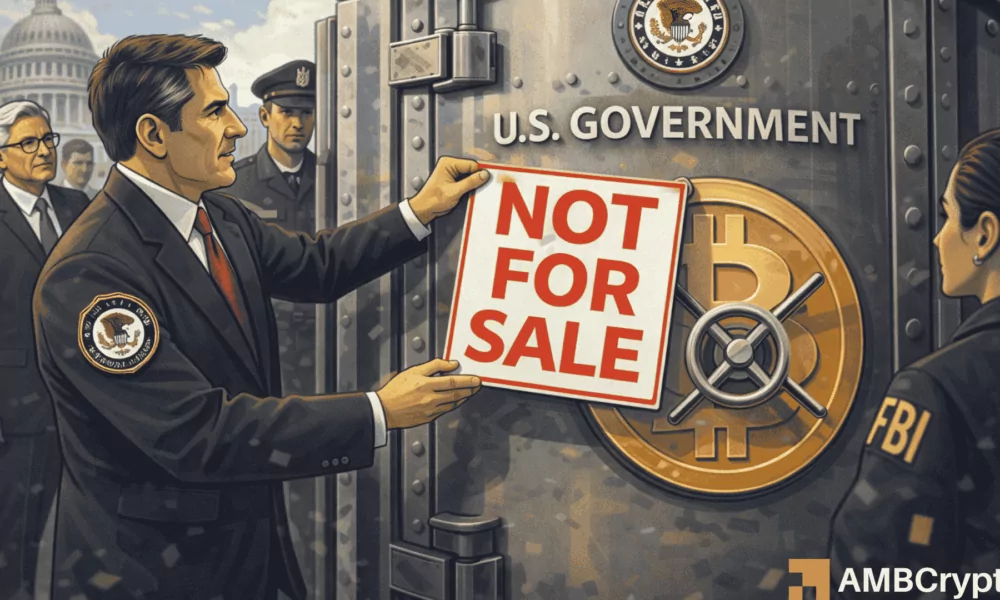
The U.S. government has officially confirmed that Bitcoin seized from Samourai Wallet developers has not been sold, countering prior speculation and reinforcing their adherence to federal policy regarding digital asset management.
A Policy-Compliant Strategic Asset
Patrick Witt, Executive Director of the President’s Council of Advisors for Digital Assets, addressed the matter, stating that the Department of Justice (DOJ) confirmed the seized Bitcoin remains on the government’s balance sheet as a strategic reserve. This reinforces Executive Order 14233, which mandates the retention of forfeited Bitcoin rather than liquidating it through public auctions as done in the past.
Witt further clarified that the assets would not be liquidated, directly countering recent reports that claimed the Bitcoin, linked to the Samourai developers, was sold in violation of this executive order. This confirmation cements the U.S. government’s compliance and provides increased clarity in an evolving regulatory environment for crypto assets.
Blockchain Data Confirms No Sales
Independent blockchain analysis from researchers at Arkham strongly supports the DOJ’s comments. Publicly accessible wallet addresses tied to U.S. government holdings show no significant reduction in Bitcoin balances, further proving that no Bitcoin linked to the Samourai case has entered the market.
Current data indicates the U.S. government holds over 328,000 BTC—valued at approximately $31 billion, alongside smaller reserves of ether (ETH) and stablecoins. The absence of unusual on-chain activity signals the adherence of the DOJ to its asset retention commitments.
Context: A Shift in Policy
Historically, cryptocurrency seized by the U.S. government was sold through public auctions, as seen in notable cases like Silk Road. These auctions set market expectations that confiscated Bitcoin would be liquidated, often impacting the cryptocurrency market.
However, Executive Order 14233 signifies a shift, emphasizing Bitcoin’s potential as a strategic reserve in federal policy. This approach has fundamentally altered the handling of forfeited digital assets, such as the Bitcoin connected to the Samourai Wallet case.
Key Takeaway for Crypto Enthusiasts
For those following the cryptocurrency markets, the DOJ’s confirmation alleviates concerns about sudden asset inflows affecting Bitcoin’s value. With no liquidation of seized Bitcoin, this reinforces trust in the government’s adherence to established policy, benefiting both market stability and regulatory clarity.
Recommended Product for Crypto Users
If you’re delving into cryptocurrency, secure your investments with a reliable wallet like Trezor Model T. This hardware wallet offers top-tier security for your Bitcoin and crypto assets, ensuring peace of mind in safeguarding your digital wealth.