Understanding 2025’s Blockchain Security Landscape
The year 2025 marks a critical turning point in blockchain security, according to the recently published SlowMist Blockchain Security & AML Annual Report. This detailed report unveils how the blockchain threat environment has evolved, showcasing organized cybercriminal activity, intensified regulatory enforcement, and the need for a proactive approach to security.
Key Findings on Blockchain Threats and Trends
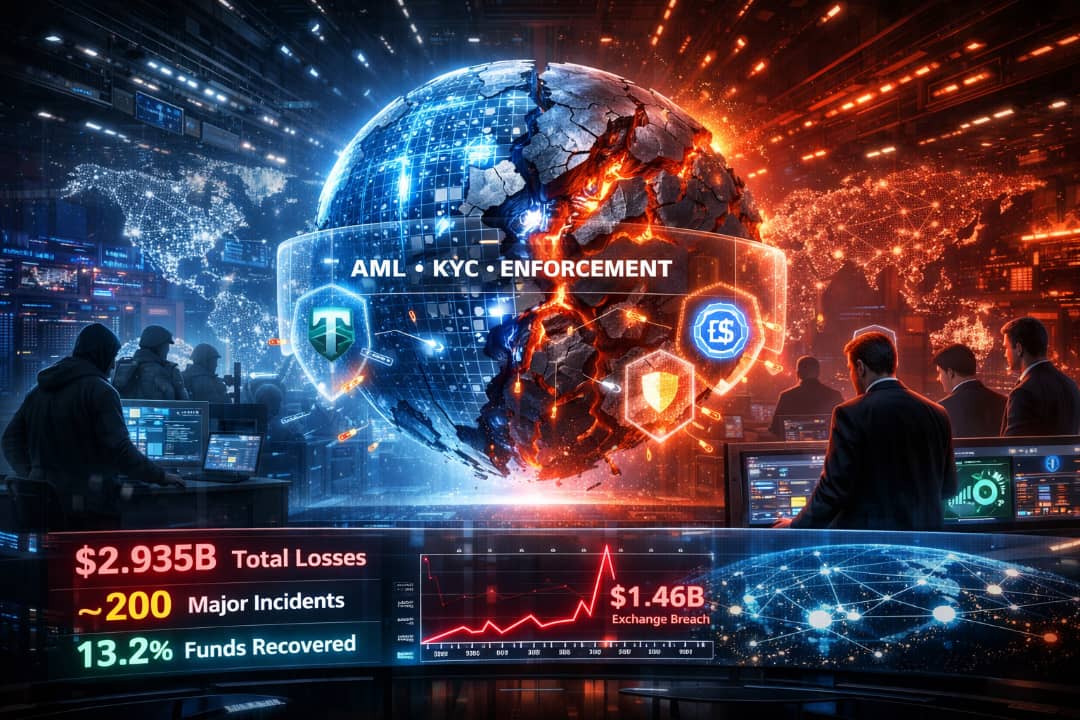
Blockchain security incidents declined in number but surged in financial impact in 2025. The report recorded 200 significant incidents, resulting in a staggering $2.935 billion in losses. For comparison, 2024 saw 410 incidents with $2.013 billion losses. Fewer attacks, it seems, now cause greater damage due to improved precision and execution by attackers.
Ethereum experienced the largest financial losses at $183.25 million, with Solana and Arbitrum following at $17.45M and $17.10M respectively. Decentralized finance (DeFi) systems led in incident counts, with 126 cases and $649M in losses, while centralized exchanges saw fewer incidents yet accounted for the highest financial damage, largely due to Bybit’s $1.46B loss. This highlights the ongoing risk tied to custodial infrastructures.
Advanced Attack Techniques in 2025
Attack vectors became increasingly sophisticated, as evidenced by the 56 smart contract exploits and 50 account compromise incidents reported. Key trends included:
- Phishing and social engineering: Multi-stage scams leveraging psychological manipulation through fake interviews, hardware wallet scams, and AI-driven impersonations.
- Supply chain attacks: Vectors leveraging malicious code in open-source libraries and developer tools.
- AI-generated fraud: Scalable deception powered by hyper-realistic text, images, and videos.
Such tactics blur the line between user responsibility and attacker control, making cybersecurity education more critical than ever.
Regulatory Enforcement Takes Center Stage
The report underscores a clear shift toward stricter regulatory enforcement in the blockchain landscape. Authorities launched aggressive crackdowns on fraud, sanctions evasion, and illicit financing, extending punitive measures beyond exchanges to include infrastructure providers. Compliance is no longer optional but a necessary baseline for any serious blockchain operation. Key priorities now include:
- AML/KYC adherence
- Tax transparency
- Custody security standards
- Stablecoin regulation
This transformation makes compliance a competitive advantage for blockchain businesses.
Progress in Recovery Efforts
Despite the growth of financial losses, recovery efforts have gained traction. For example, Tether and Circle froze compromised funds on over 700 Ethereum addresses, recovering around $387M in stolen assets. SlowMist supported critical investigations, helping clients recover $19.29M. This highlights the importance of advanced recovery protocols and real-time monitoring tools.
Industrialization of Cybercrime
Cybercrime in 2025 became even more industrialized. DPRK-linked hacker groups, ransomware-as-a-service (RaaS), and malware-as-a-service (MaaS) platforms reduced barriers to entry and expanded illicit operations. Underground laundering pipelines, spearheaded by decentralized privacy tools and mixers, further complicated regulatory enforcement.
However, enforcement actions like dismantling fraudulent networks and malware platforms such as LockBit and LummaC2 showcased progress toward disrupting cybercrime infrastructure.
Securing a New Era of Blockchain
As blockchain evolves into critical infrastructure, the cost of entry now includes robust security frameworks, regulatory compliance readiness, and real-time on-chain monitoring. The advancements by SlowMist, including AI-driven tools like MistEye and MistTrack, demonstrate the industry’s direction toward automated detection, recovery, and compliance solutions.
If you’re a blockchain investor or developer, consider integrating SlowMist services to ensure your Web3 projects stay ahead of evolving threats.
Key Takeaways
Blockchain in 2025 is no longer just an experimental frontier. It has become critical infrastructure requiring stringent security, compliance measures, and continual vigilance. Stay proactive to navigate this increasingly complex landscape.