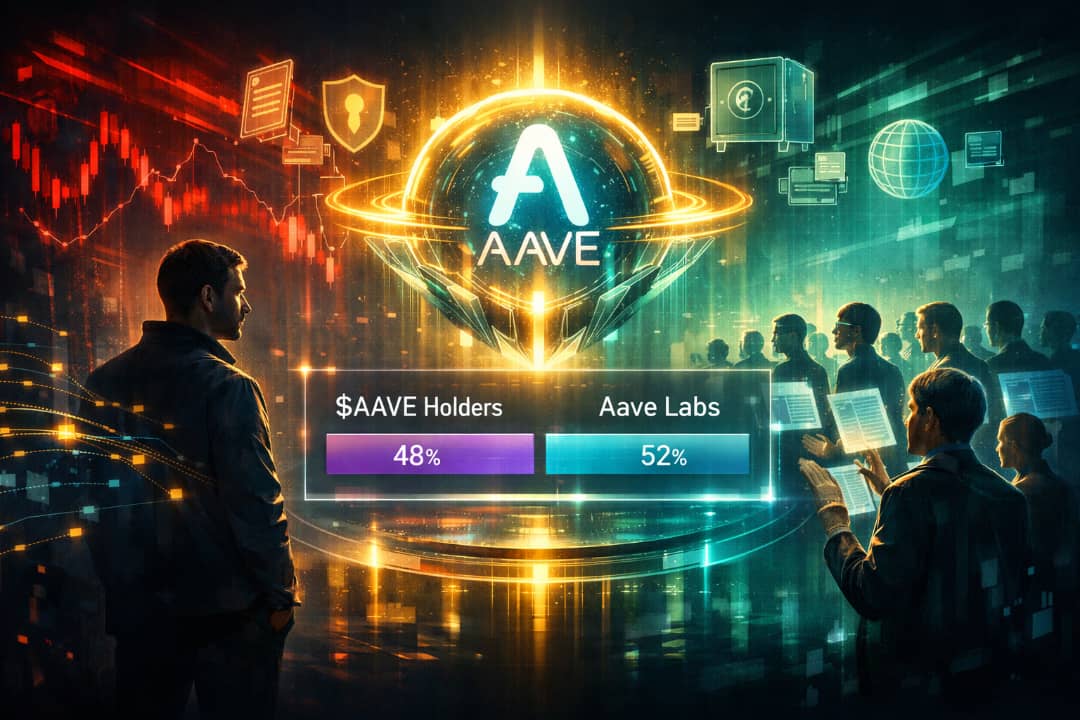
The Aave Ecosystem Faces Governance Challenges
Aave, one of the leading decentralized finance (DeFi) protocols, recently experienced a turbulent governance debate that has captured the attention of the crypto community. Founder Stani Kulechov openly addressed the growing concerns around governance, token holder alignment, and transparency. The debate was sparked by a contentious DAO vote, exposing tensions between Aave Labs and $AAVE token holders.
Messy Governance: A Sign of a Healthy Decentralized System
In a public statement, Kulechov described the governance debate as both challenging and vital for Aave’s long-term growth. He noted, “The recent governance debate may feel chaotic, but it’s a feature, not a bug, of decentralized systems.” While admitting that Aave Labs hasn’t always done the best job explaining its relationship with token holders, Kulechov promised more transparency moving forward. Clearer communication on how products built by Aave Labs generate value for the DAO and $AAVE holders will now be a priority.
Aave DAO’s Financial Highlights
A critical point emphasized during the debate was the financial strength of the DAO. According to Kulechov, the Aave DAO generated an impressive $140 million in revenue this year, a notable increase compared to the preceding three years combined. Importantly, control of the treasury remains entirely with $AAVE token holders, further demonstrating the decentralized nature of the protocol. Despite criticism, Kulechov argued that the DAO is functioning as intended and stands stronger than ever.
The Governance Flashpoint
The recent tensions stemmed from a DAO proposal aimed at transferring ownership of Aave’s intellectual property—domains, social media accounts, and naming rights—entirely into DAO control. Surprisingly, the proposal failed to pass, further igniting concerns about centralization. The controversy deepened when it was discovered that fees from Aave Labs’ partnership with CoWSwap were being routed to Aave Labs’ wallet instead of the DAO, raising governance oversight concerns.
Market Reactions to the Governance Debate
The uncertainty surrounding the discussion had swift consequences. $AAVE prices dropped by roughly 19% in just one week, showcasing the direct impact governance decisions can have on market sentiment, even with well-established DeFi protocols. Adding to the tension were reports of Kulechov personally purchasing $10 million to $15 million worth of $AAVE tokens. Some accused him of consolidating voting power, a claim he refuted by clarifying that these tokens were not used in voting.
Aave’s Resilience in the DeFi Ecosystem
Despite this turbulence, Aave remains a cornerstone of decentralized finance. As the largest lending platform in DeFi, Aave plays a critical role in enabling borrowing, lending, and liquidity across multiple blockchains. Usage metrics and integrations highlight the protocol’s importance, even amid internal challenges. “This is my life’s work,” Kulechov reiterated, reaffirming his dedication to the project.
Moving Forward: Collaboration and Transparency
Kulechov concluded by emphasizing the need for collaboration within the ecosystem. He stated, “Alignment will not come from control, but from cooperation.” The recent governance debate has exposed weaknesses in the system, but it also offers an opportunity for growth. Transparency, better communication, and shared ownership will be key to Aave’s ongoing success.
Recommended Product
For those venturing into cryptocurrency investments, consider securing your digital assets with the Ledger Nano X, a best-in-class hardware wallet ensuring optimal security for all your tokens including $AAVE.
Disclaimer: This is not investment advice. Please conduct thorough research before buying cryptocurrencies.


