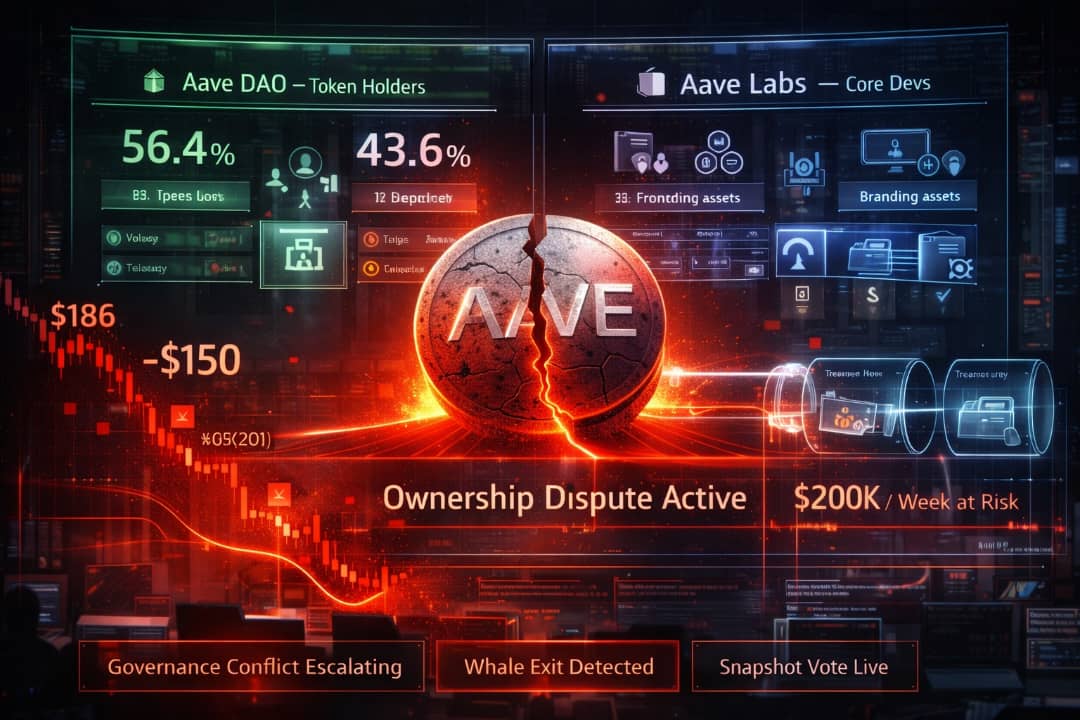
Decentralized finance (DeFi) has always promised a world driven by token holders rather than centralized entities. However, the recent turmoil surrounding Aave, one of DeFi’s most prominent protocols, challenges this fundamental promise. At the center of the controversy lies an escalating governance dispute between Aave Labs, the centralized development entity behind the protocol, and factions within the Aave DAO. The repercussions of this conflict are reshaping the Aave market and raising questions about the future of decentralization in DeFi.
Aave’s Token $AAVE Struggles Amid Governance Tensions
The $AAVE token has dropped approximately 19.5% over the last week, trading around $150 as confidence in the protocol falters. According to CoinGecko, the decline coincides with governance tensions as whales start exiting their positions and markets react to volatile events.
What began as a disagreement over revenue alignment has evolved into a bitter debate about ownership. Does governance from token holders dictate protocol control, or does centralized coordination ensure its development and sustainability? This significant question lies at the heart of the Aave dispute and speaks volumes about the challenges DeFi faces as it matures.
The Flashpoint: CoW Swap Controversy
The dispute ignited in early December 2025, when Aave Labs announced integration with CoW Swap in place of VeloraDEX. The new integration promised better user experience, stronger MEV protection, and improved pricing but also triggered concern over revenue distribution. Prominent Aave DAO delegate, DeFi_EzR3aL, revealed that swap fees were no longer flowing into the DAO treasury. Instead, these fees, which historically earned roughly $200,000 a week for the DAO, were redirected to wallets controlled by Aave Labs.
This move led to accusations of “stealth privatization” of DAO income. Marc Zeller, a key voice within the Aave community, highlighted how this change undermined the DAO’s authority. As the dialogue grew contentious, proposals emerged with some advocating for radical steps, including taking over Aave Labs’ intellectual property and branding.
Markets Respond to Governance Drama
The uncertainty and tension haven’t gone unnoticed by the market. One significant whale sold over 230,000 $AAVE tokens, worth approximately $37 million, driving AAVE’s price down by more than 10% within 24 hours. Analysts speculate this wasn’t panic selling but rather a calculated move to mitigate risk amidst governance instability.
Amid this backdrop, a Snapshot vote spearheaded by Aave Labs founder Stani Kulechov is underway. The proposal, which focuses on brand ownership and intellectual property rights, has sparked divisive opinions. Critics argue its timing, during the holiday season, limits participation and undermines democracy, while supporters see it as an opportunity for decentralization.
The Bigger Picture: Challenges in DeFi Governance
The ongoing dispute highlights a broader tension in DeFi. While protocols are governed by smart contracts and DAOs, the user-facing interfaces, branding, and strategic decisions often remain under centralized entities like Aave Labs. This hybrid model poses important questions about the limits of decentralization.
If token holders succeed in asserting control at Aave, it could inspire DAOs across the DeFi sector to pursue greater autonomy. However, if centralized entities retain authority, it may highlight the constraints of decentralization in practice. Either way, the industry is closely watching Aave as it undergoes this critical test.
How to Manage the Risks of Cryptocurrency Investments
The Aave situation underscores the importance of DYOR (Do Your Own Research) when investing in cryptocurrency. As governance disputes can significantly impact prices, keeping an eye on protocol developments and participating in community votes may help mitigate risks. Products like the Ledger Nano X, a secure hardware wallet, can help you safely store your crypto assets amid market uncertainty.
Disclosure: This article is not financial advice. Always conduct your research and consult with professionals before making investment decisions.



