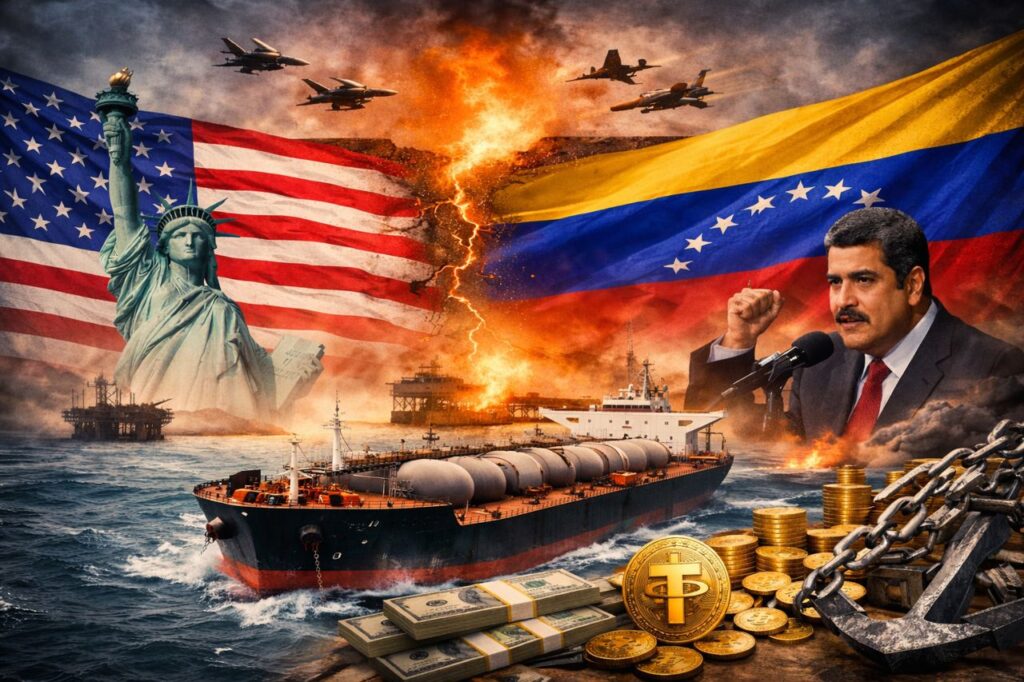
Despite headlines claiming recovery, Venezuela finds itself burdened with economic and political uncertainty as the country approaches 2026. Deep structural weaknesses and geopolitical tensions continue to define Venezuela’s precarious state. Experts agree that without major reforms, Venezuela’s economic fragility is likely to persist, with devastating impacts on ordinary citizens.
Understanding the Scale of Economic Decline
Venezuela’s gross domestic product (GDP) has seen a staggering contraction of nearly 75% since its peak of $460 billion in 2012. By 2025, the International Monetary Fund estimates the GDP will hover just above $109 billion. On a per-capita basis, GDP has fallen from approximately $15,500 to an unsettling $2,500. Economist Aldo Contreras describes this trend as part of a prolonged economic crisis, characterized by diminished industrial output, weak investments, and structural fragility.
Inflation remains a crippling issue, with independent estimates pointing to rates as high as 600% by 2026. Furthermore, the Venezuelan bolívar’s depreciation and the growing disparity between official and parallel exchange rates continue to distort the economy. If these trends persist, the bolívar could plunge to 450 per US dollar by 2026, potentially triggering another bout of hyperinflation, as seen between 2016 and 2018.
Key Challenges Facing Venezuela
The situation remains dire for much of the population. Currently, over 70% of Venezuelans earn less than $50 a month, and income inequality has reached unprecedented levels. While the government highlights growth figures for 2024 and 2025, these numbers fall woefully short in meeting former benchmarks of prosperity. Only 6% of working Venezuelans now make above $1,000 per month.
Political instability further complicates the landscape. Tensions between Venezuela and the United States escalated in December after former President Donald Trump announced stricter sanctions, including the seizure of sanctioned oil tankers. Venezuela’s oil industry—a vital economic engine—accounts for over 83% of hard-currency inflows. However, US sanctions have rendered the state-owned PDVSA reliant on steeply discounted oil sales to foreign partners such as China.
Small businesses, fueled by $4 billion in yearly remittances, represent a rare bright spot in the economy. However, key sectors like construction, agriculture, and manufacturing have stagnated, underscoring the fragility of Venezuela’s limited growth. Tax revenue has increased, but wages have not, and access to credit remains constrained by tight monetary policies.
Cryptocurrency as a Financial Lifeline
With limited access to formal international markets, Venezuela has seen a rapid embrace of cryptocurrency. Blockchain analytics firm Chainalysis estimates the country transferred nearly $44.9 billion in digital assets over the past year. Stablecoins like USDT have gained traction as a key financial tool for Venezuelans, particularly within industries restricted by international sanctions. Reports suggest PDVSA has used stablecoins as payment for some oil transactions, circumventing traditional currency systems.
For those navigating volatile currency fluctuations and limited banking solutions, hardware wallets such as the Ledger Nano S have become indispensable. This secure device protects your cryptocurrency investments and enables seamless access—a crucial tool for navigating Venezuela’s uncertain financial landscape.
Outlook for 2026: Increased Tensions and Uncertainty
Looking ahead, escalating political confrontations and the potential intensification of US sanctions pose significant risks. Political analyst Pablo Quintero warns that growing external pressures may compel Venezuela’s government to double down on propaganda, fostering a survivalist narrative that strengthens its base while stalling reform efforts. Meanwhile, diplomatic stalemates with countries like Russia and China leave Venezuela further isolated on the global stage.
The potential expansion of oil sanctions could have far-reaching consequences for the fragile economy. Projections of 6.5% GDP growth in 2026 could be derailed if oil revenues decline due to embargoes. Analysts suggest such scenarios risk renewing cycles of hyperinflation and plunging ordinary citizens deeper into poverty.
Is Hope on the Horizon?
Achieving sustainable growth for Venezuela requires more than sanctions relief. Comprehensive structural reforms are key to unlocking the potential of dormant sectors like tourism, agriculture, and manufacturing. Additionally, increased adoption of cryptocurrencies offers a promising alternative for residents and businesses seeking financial stability under challenging conditions.
For individuals affected by Venezuela’s crisis or intrigued by its crypto adoption, platforms like Coinbase provide beginner-friendly solutions for buying and managing digital assets. With an easy-to-use interface and robust security measures, Coinbase stands out as a reliable choice for those new to cryptocurrency investing.
Without urgent reforms and meaningful political dialogue, however, the convergence of external sanctions, internal economic fragility, and political conflict risks keeping Venezuela trapped in a cycle of instability.


1 thought on “Venezuela’s Economic Crisis: Challenges and Prospects for 2026”
Comments are closed.