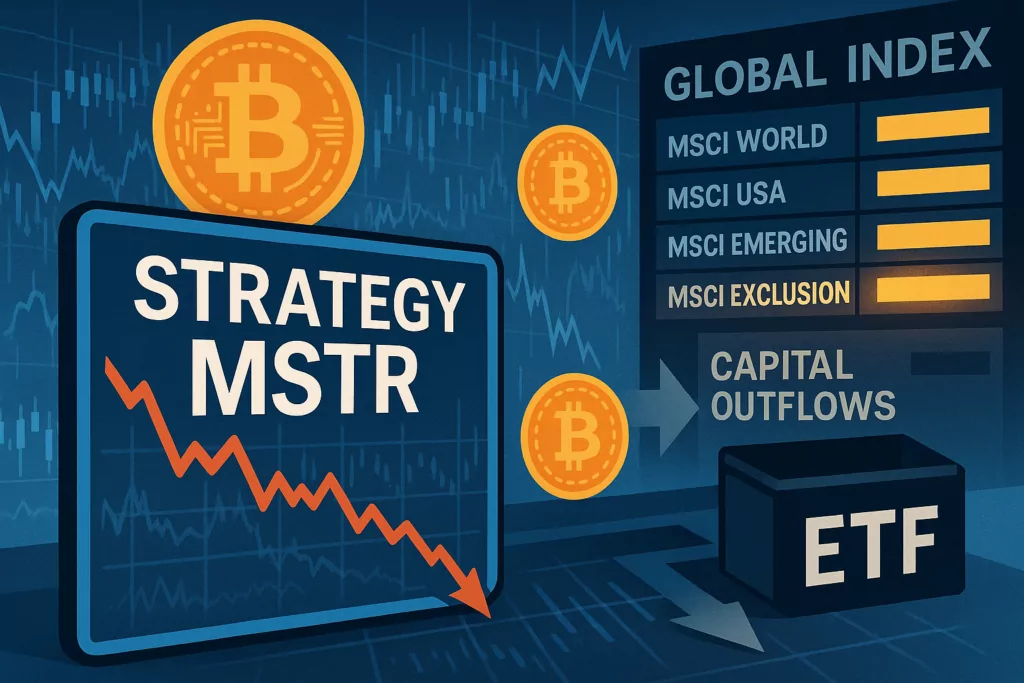
Strategy (MSTR), the world’s largest corporate holder of Bitcoin, is navigating a pivotal moment as MSCI, a global leader in indexing, evaluates whether to exclude the company from major equity benchmarks. This decision, expected on January 15, holds significant ramifications for Strategy’s market positioning, financial flexibility, and investor confidence.
What’s at Stake for Strategy?
Currently, Strategy is listed in the MSCI USA and MSCI World indices. A possible exclusion could lead to outflows estimated at $8.8 billion, as highlighted by JP Morgan. With a substantial portion of Strategy’s valuation tied to passive investments like ETFs, losing benchmark inclusion could greatly impact the company’s liquidity and reputation among investors.
In response to these challenges, Strategy’s Chairman Michael Saylor has confirmed ongoing discussions with MSCI to address the risks. However, Saylor admitted, “The equity is going to be volatile because the company is built on amplified Bitcoin,” reflecting the unique risks of their heavily Bitcoin-dependent model.
A High-Risk Approach Meets Market Volatility
Strategy’s business model revolves around cryptocurrency treasuries, leveraging Bitcoin as a key asset. While this approach has propelled the company to new heights during Bitcoin’s highs, the recent pullback in the cryptocurrency market has introduced turbulence. Since hitting a record high above $120,000 in October, Bitcoin has now declined sharply, affecting Strategy’s market value. This downturn aligns with broader investor caution on risk-laden assets amidst concerns about an AI-driven market bubble, macroeconomic instability, and high tech valuations.
Strategy’s share price has fallen more than 37% in 2025, intensifying investor concerns. The MSCI review takes place during this period of volatility, with the outcome potentially influencing how index providers assess Strategy’s long-term stability and suitability.
Implications of MSCI’s Decision
Inclusion in MSCI indices is more than just a status symbol—it brings visibility, steady liquidity, and frequent passive inflows. Should MSCI opt for exclusion, Strategy risks losing access to these benefits, reshaping its investor base and putting pressure on its ability to raise capital for future growth. Moreover, a shift away from benchmark inclusion would likely elevate skepticism around its heavily leveraged exposure to cryptocurrency.
For a company whose performance is intrinsically linked to Bitcoin’s value, the stakes are incredibly high. As Saylor points out, “If Bitcoin falls… 30%, 40%, then the equity is going to fall more, because the equity is built to fall.” This underscores why January 15 is a critical date for Strategy and its future trajectory.
Investors: Adapting to the Landscape
For investors interested in the cryptocurrency sector despite its volatility, exploring diversified crypto-backed ETFs could be a less risky alternative. Consider options like the Global X Blockchain & Bitcoin Strategy ETF, which offers exposure to Bitcoin through a mix of futures contracts and blockchain-based investments. This strategy helps mitigate direct crypto risks while still capitalizing on the market’s potential growth.
As Strategy faces its MSCI review, the outcome will ripple through the broader crypto and investment sectors. Whether the company adapts to its challenges or struggles under the weight of its concentrated model, this moment serves as a critical case study in cryptocurrency’s integration into traditional finance.