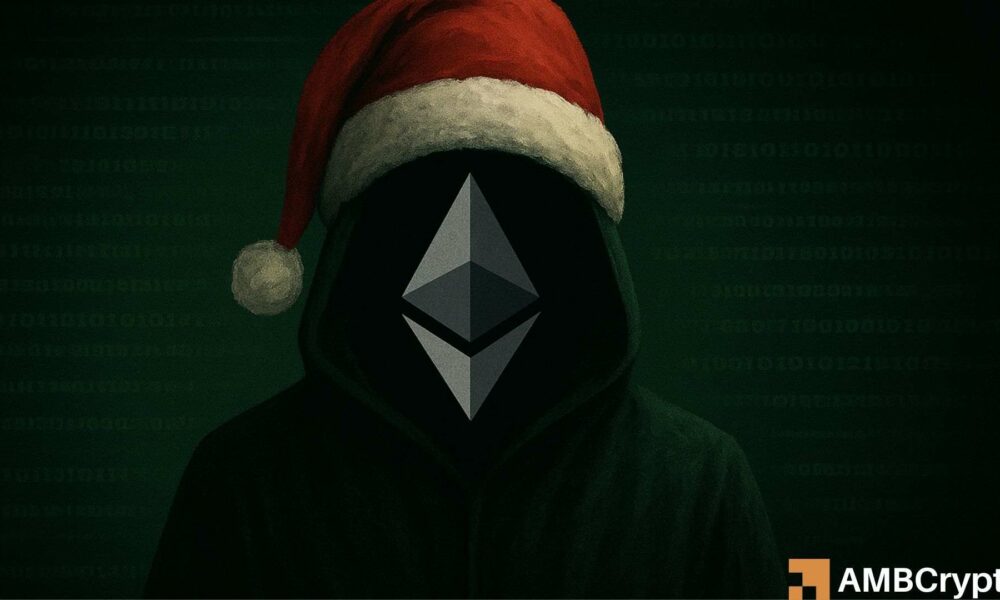
Privacy Takes Center Stage in Ethereum’s Ecosystem
The topic of privacy continues to dominate discussions within the Ethereum ecosystem, particularly as the holiday season brings a new spotlight to decentralized solutions. Recently, an Ethereum developer announced an innovative ‘Secret Santa’ protocol designed to facilitate anonymous gifting, pushing the boundaries of privacy-focused blockchain applications.
The Evolution of Privacy on Ethereum
This isn’t Ethereum’s first foray into privacy. In September, the Ethereum Foundation revealed an ambitious privacy roadmap aimed at improving user experiences across all levels of its ecosystem. The roadmap introduced initiatives for private payments, enhanced integration of private transactions for both retail and institutional use cases, and upgrades to user-facing wallets.
The Kohaku framework, for instance, has been pivotal in enabling private wallet features. These advancements align with Ethereum’s broader mid-term goals of optimizing privacy, scaling, and incorporating Artificial Intelligence (AI) into its framework. By addressing these areas, Ethereum is not only improving transactional security but maintaining its competitive edge over other blockchains like Solana.
Layer 1 vs Layer 2: A Burning Debate
One of the ongoing debates in the Ethereum community revolves around Layer 1 (L1) versus Layer 2 (L2) scaling solutions. Recent scalability efforts, such as Pectra and Fusaka, have made Ethereum L1’s transaction costs more competitive, encouraging developers to build directly on L1. Notably, Ethereum’s founder, Vitalik Buterin, has stated that the low costs make L1 development feasible for many applications.
However, this perspective has been met with criticism. Analysts like Dan Smith argue that the largest consumers of Ethereum’s resources are general-purpose L2s, which they believe are in direct competition with L1. To support his argument, Smith likened the situation to carpenters (L2s) versus lumber yards (L1s)—suggesting they serve different purposes.
Other experts, such as Hasu, have countered this perspective, drawing comparisons to companies like Apple, which sell their products through their own channels and third-party platforms like Amazon. This dynamic illustrates that there is room for both L1 and L2 solutions to coexist and attract developers.
The Economic Value Tug-of-War
The competition between Ethereum’s L1 and its L2s adds a layer of complexity to ETH tokenomics. Data shows that L2s capture significant economic value, often sharing minimal fees with the Ethereum mainnet. For instance, the Coinbase-incubated L2 chain, Base, generated over $3.4 million in fees within a 24-hour period but contributed only $3,700 as “rent” to L1. Such imbalances have led some analysts to suggest that L2s extract more value from Ethereum than they return, potentially dragging down the value of the ETH token.
A Path Forward for Ethereum
As the Ethereum community looks to the future, integrating scaling and privacy solutions will play a critical role in improving the platform’s tokenomics and bolstering demand for ETH. Innovations like the ‘Secret Santa’ protocol exemplify Ethereum’s efforts to solidify its reputation as both a privacy-centric and scalable blockchain ecosystem.
An Ideal Product for Privacy Enthusiasts
If you’re looking to secure and anonymize your cryptocurrency transactions, consider the Ledger Nano X hardware wallet. With advanced security features and offline storage, it’s perfect for protecting your ETH and other digital assets. Check out the Ledger Nano X for a heightened level of security and privacy.



